By: Hassan Turaki.
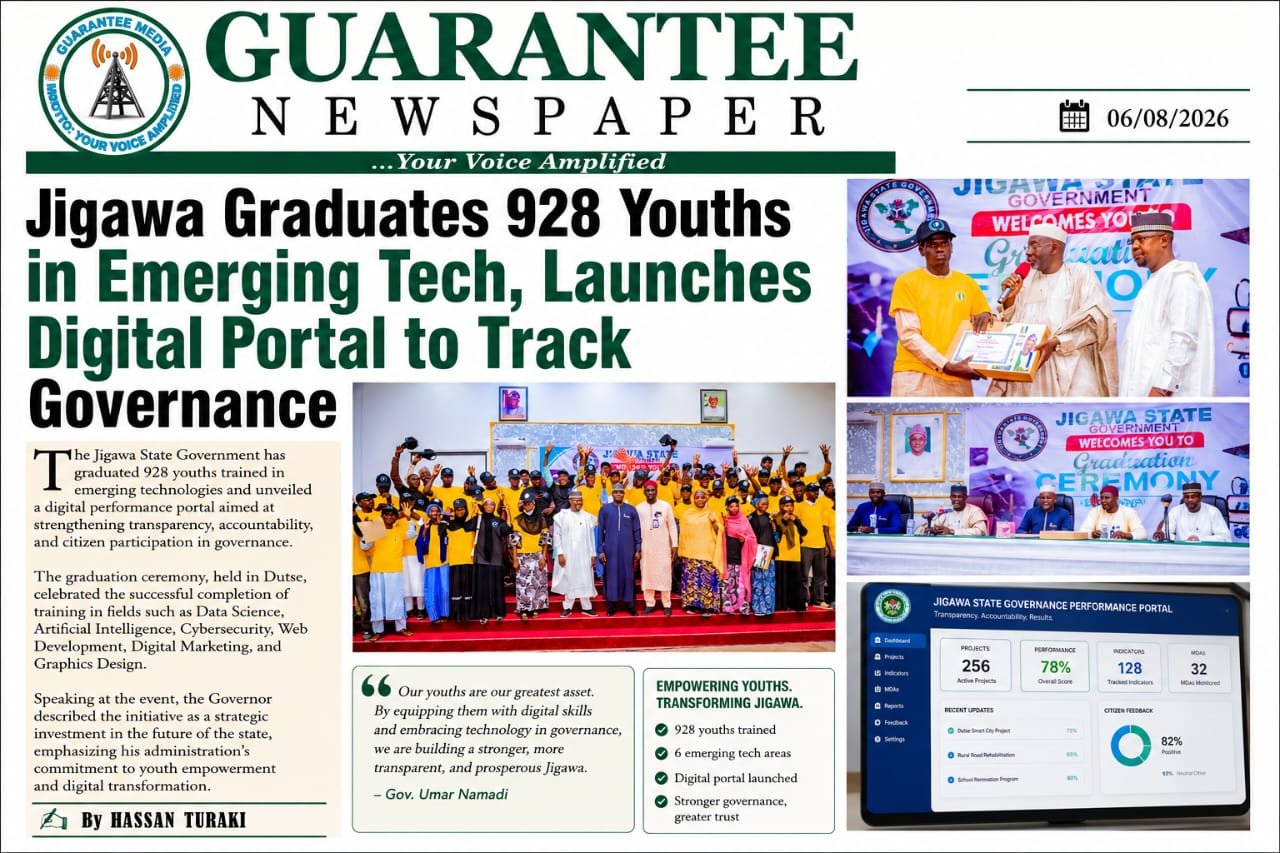
The Jigawa State Government has graduated 928 youths trained in emerging technologies and unveiled a digital performance portal aimed at strengthening transparency, accountability, and citizen participation in governance.
Governor Malam Umar Namadi presided over the ceremony at the Banquet Hall, Government House, Dutse.
The one-year professional diploma was delivered under the World Bank-assisted IDEAS Project, coordinated by the Federal Ministry of Education and facilitated by Baze University, Abuja.
The event was also attended by the Minister of Education, Dr. Moruf Olatunji Alausa, and the Minister of State for Education, Prof. Suwaiba Sa’id Ahmad.
The graduands acquired skills in applied artificial intelligence, blockchain, business intelligence, data analytics, digital literacy, software engineering, cybersecurity, and other market-relevant competencies.
Governor Namadi described the programme as a strategic investment in human capital to drive Jigawa’s digital economy and youth empowerment.
“This milestone is part of a deliberate effort to build a critical mass of Jigawa citizens with the professional capabilities required to power our digital economy, support innovation, and compete in technology-driven organizations,” the governor said.
To reward excellence, 30 outstanding participants will receive laptops, while four others have secured jobs with Baze University.
A major highlight was the launch of the Jigawa State 12-Point Agenda Digital Performance Portal.
The platform will provide citizens, investors, and development partners with real-time information on government programmes and projects across all 27 LGAs and 287 wards.
“The portal is designed to give citizens and partners clearer access to timely and credible information on government performance,” Governor Namadi stated, noting it will further strengthen accountability in service delivery.
The governor also outlined other ICT initiatives including JITDA, J-COMPETE, J-UNITE, the State ICT Master Plan with NITDA, Community ICT Centres, digital skills training with GLUWA, and e-government capacity building with KOICA.
He urged graduands to apply their skills with discipline and creativity to drive innovation.
In his keynote, Dr. Alausa described the graduation as a landmark for Nigeria’s knowledge economy and announced plans for a Digital Training Academy under the 3MTT programme.
Prof. Suwaiba also commended the state’s investment in human capital and the portal as a tool for effective public service delivery.