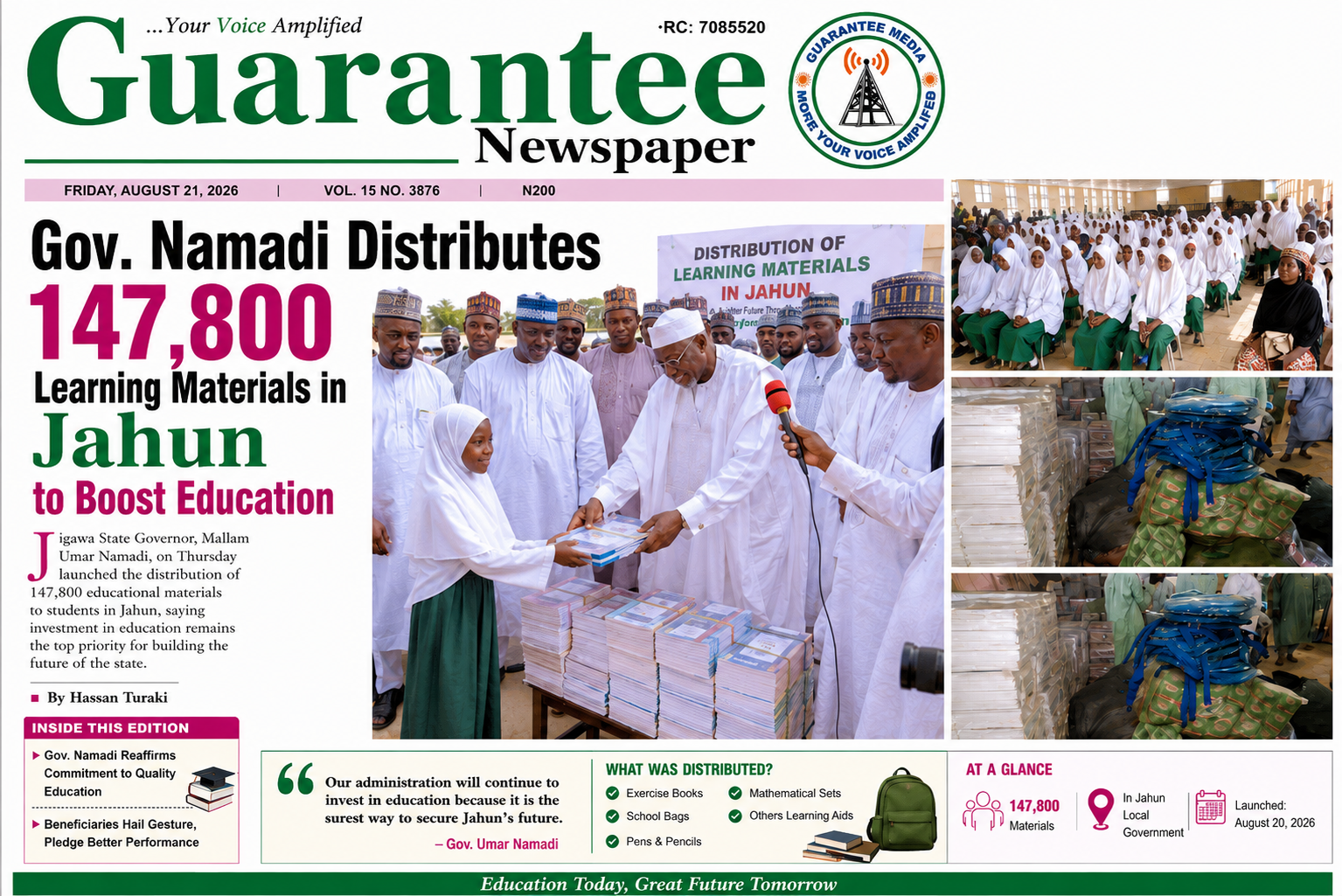
BY: Hassan Turaki.
Jigawa State Governor, Mallam Umar Namadi, on Thursday launched the distribution of 147,800 educational materials to students statewide, saying investment in education remains the top priority for building the future of the state.
Speaking at the ceremony, Namadi described the initiative as part of his government’s wider plan to upgrade school facilities, improve teacher capacity, and expand access for disadvantaged learners, with special focus on girls and Tsangaya students.
Citing 2024 data from the Federal Ministry of Education, the governor said Jigawa has 1,642,807 pupils across 4,568 schools.
The data also showed a learner-to-teacher ratio of 63.6:1 and learner-to-classroom ratio of 77.6:1, while girls made up 49.5% of total enrolment. The 2025 census report is still being awaited.“These numbers show that demand for education in Jigawa is rising,” Namadi noted.
“They also remind us of the urgent need to build more classrooms, hire and fairly deploy teachers, and support children at risk of dropping out.
”On the Support Items for Post-Basic GirlsThe first phase targets female students at post-basic level and includes: 48,300 school uniforms, 15,000 school bags, 40,000 sanitary pads, 4,000 sets of writing materials, 40,000 exercise books.
According to the governor, the items are meant to ease financial pressure on parents, boost school attendance, promote menstrual hygiene, and uphold the dignity of girl learners.
He further disclosed that contracts have been awarded for basic-level support, covering 22,500 uniforms for JSS students and 11,000 uniforms for nomadic schools, in addition to bags, sandals, school boxes and exercise books.
Through the Tsangaya Education Board, 3,800 uniforms will be distributed to Almajiri pupils in integrated Tsangaya schools.
“Our goal is to blend Qur’anic education with literacy, numeracy, life skills, and opportunities for self-reliance,” he explained.
The governor also outlined ongoing steps such as recruiting and training teachers, constructing and renovating schools, and ensuring equitable teacher deployment to reduce overcrowding.
Namadi urged parents, educators, traditional rulers, religious leaders, SBMCs, CSOs and development partners to collaborate with government to make the program succeed.
“Giving out materials is not enough,” he said. “Real results will come from family support, teacher commitment, community involvement, and students’ discipline.”
He assured that his administration will keep treating education as a right and a driver of change until every child in Jigawa has access to quality learning.
The event drew government officials, education stakeholders, and representatives of benefiting schools.